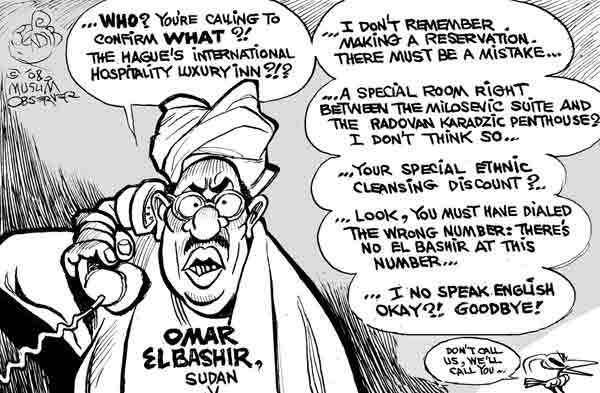
The ICC is unable to fulfill its mandate. The Organization cannot manage to arrest a man known for committing genocide, because it has no means of enforcement of its decisions. This is devastating to its cause and its reputation.
The whole point of such an organization is to deter humans from acting out such inhumane and widespread campaigns as genocide. It is to balance against powerful individuals who feel they have no constraints under national law. This is especially the case for leaders who incite acts of terrorism against their citizens.
Leaders, however, are extremely difficult to arrest once and international warrant has been passed by the jury. They are not likely to be turned in on their own soil, so the ICC has to wait for them to leave. Even once they leave, it is unlikely that a non-signatory of the Rome Statute will turn them over and risk aggrivating their political relationship with the accused criminal's government.
This is especially a problem with people from regions of the world that feel bombarded by Western principles and culture. Arab people/countries and Latin American people/countries tend to stick together when culturally "attacked" by the West. They have a sort of brotherhood that prevents such violations of trust amongst them. One country would not want to be shunned by their brotherhood for turning one of their kind over to the "other" side.
They tend to look the other way when one of their own is committing atrocious acts. They do this to ensure they receive the same allegiance when they themselves resort to such acts. In other words, the Ethiopian leader will not turn over Al-Bashir, expecting the same from Sudan if he had a ICC warrant out for his arrest.
So how do we fix a world divided by culture? How do we overcome such obstacles to IL as the debate over universalism and relativism? These problems have yet to be solved, but that does not mean all hope is lost. We must keep spreading the word about Darfur. We must encourage our own countries (USA) to sign on to the statute and help enforce the decisions of ICC. We must keep pushing for the people living in camps in Darfur. We must keep fighting for the people who have yet to be victimized at the hand of those more powerful than them. We have to keep International Law alive and revive its credibility!
Showing posts with label International Criminal Court. Show all posts
Showing posts with label International Criminal Court. Show all posts
Tuesday, March 31, 2009

Sunday, March 29, 2009
Doha, Qatar: Arab League Summit
The Arab League Headquarters in Cairo.
Picture by Amarune on Flickr.
 Ethiopia, Egypt, Eritrea, and now the Arab League Summit in Qatar: Omar Al-Bashir has become the poster boy for the Arab world's defiance of Western domination in global politics.
These four countries are not signatories of the Rome Statute and the ICC was not optimistic about their cooperation. In fact, only three Arab League members, Jordan the Comoros and Djibouti, are signatories of the ICC charter. The United States of America is not even a signatory state! It has military warplanes and 5,000 American troops stationed there and could put a lot of pressure on Qatar, but it does not support the ICC mandate. NO ONE would be bold enough to take such drastic measures as to arrest the Al-Bahir on friendly soil.
So how will the international criminal parade into a multinational meeting with no fear of imprisonment? It appears that he may have the support of many of his fellow Arab nationals. The Sudanese leader was there on a mission to discuss the recent release of an arrest warrant by the ICC. Col Gaddafi, a friend and ally of Mr. Al-Bashir told BBC reporters that the document was a "practice of First World Terrorism". He reflects the perceptions of many in the Arab world, that this is a bullying tactic of the west.
What is obviously unclear or unimportant to them is that this man is killing hundreds of thousands of his own people both directly and indirectly.
The ICC hopes Sudan's allies who have signed and ratified the "Rome Statute" will remain faithful to their promises over their national interest; that has yet to be challenged.
As it is, the leader was welcomed with hugs and kisses to the summit by Hamad Bin Khalifa Al-Thani, the standing head of Qatar. The ICC did not expect the leader to be so brazen in his resistance of their arrest warrant and were unsuspecting of this latest appearance in Qatar on the evening of March 29, 2009. Even with such figures as the UN Secretary General, Ban Ki Moon, in attendance, he will be present and, predictably, outspoken in the next few days of meetings for the AL Summit. He will likely exit the summit without any obstacles and leave a free man. We will see if anything is done once he boards a plane, therefore entering international territory.
This highlights the weakness of the ICC, especially without the support of the US. The US has political, economic and military leverage that could be used to pressure these leaders. Without that or some other form of enforcement the whole document is an empty threat. We need to improve the international criminal system before making anymore similar charges. The court's reputation is dwindling at the moment, and it is under great criticism for the effect of the warrant on Darfur civilians and its handicapping of humanitarian aid to them.
This court has to obtain some sort of enforcement squad. They need to be able to follow through with their threats or they will never be accepted as an actor in IR. No one will abide by a law that has no repercussions. Leaders who want to commit genocide will not have anything to fear if they are discovered.
We need to fix this system.
We need to improve the international legal system or major war criminals will be allowed to continue their treachery. We need to protect the survivors in Darfur and those like them from inhumane treatment. We are all human, how can we allow this to go on any longer. In my next post, I will discuss ways that YOU can make a difference in Darfur and improve the entire Global Community.
Check out this cartoonist's take on the situation. It will give you a good chuckle.
Picture by Amarune on Flickr.
Ethiopia, Egypt, Eritrea, and now the Arab League Summit in Qatar: Omar Al-Bashir has become the poster boy for the Arab world's defiance of Western domination in global politics.These four countries are not signatories of the Rome Statute and the ICC was not optimistic about their cooperation. In fact, only three Arab League members, Jordan the Comoros and Djibouti, are signatories of the ICC charter. The United States of America is not even a signatory state! It has military warplanes and 5,000 American troops stationed there and could put a lot of pressure on Qatar, but it does not support the ICC mandate. NO ONE would be bold enough to take such drastic measures as to arrest the Al-Bahir on friendly soil.
So how will the international criminal parade into a multinational meeting with no fear of imprisonment? It appears that he may have the support of many of his fellow Arab nationals. The Sudanese leader was there on a mission to discuss the recent release of an arrest warrant by the ICC. Col Gaddafi, a friend and ally of Mr. Al-Bashir told BBC reporters that the document was a "practice of First World Terrorism". He reflects the perceptions of many in the Arab world, that this is a bullying tactic of the west.
What is obviously unclear or unimportant to them is that this man is killing hundreds of thousands of his own people both directly and indirectly.
The ICC hopes Sudan's allies who have signed and ratified the "Rome Statute" will remain faithful to their promises over their national interest; that has yet to be challenged.
As it is, the leader was welcomed with hugs and kisses to the summit by Hamad Bin Khalifa Al-Thani, the standing head of Qatar. The ICC did not expect the leader to be so brazen in his resistance of their arrest warrant and were unsuspecting of this latest appearance in Qatar on the evening of March 29, 2009. Even with such figures as the UN Secretary General, Ban Ki Moon, in attendance, he will be present and, predictably, outspoken in the next few days of meetings for the AL Summit. He will likely exit the summit without any obstacles and leave a free man. We will see if anything is done once he boards a plane, therefore entering international territory.
This highlights the weakness of the ICC, especially without the support of the US. The US has political, economic and military leverage that could be used to pressure these leaders. Without that or some other form of enforcement the whole document is an empty threat. We need to improve the international criminal system before making anymore similar charges. The court's reputation is dwindling at the moment, and it is under great criticism for the effect of the warrant on Darfur civilians and its handicapping of humanitarian aid to them.
This court has to obtain some sort of enforcement squad. They need to be able to follow through with their threats or they will never be accepted as an actor in IR. No one will abide by a law that has no repercussions. Leaders who want to commit genocide will not have anything to fear if they are discovered.
We need to fix this system.
We need to improve the international legal system or major war criminals will be allowed to continue their treachery. We need to protect the survivors in Darfur and those like them from inhumane treatment. We are all human, how can we allow this to go on any longer. In my next post, I will discuss ways that YOU can make a difference in Darfur and improve the entire Global Community.
Check out this cartoonist's take on the situation. It will give you a good chuckle.
Challenging ICC and International Law
How effective or ineffective is the ICC?
The biggest obstacle to implementing International Law (IL) acted out through supranational authorities such as the International Criminal Court and other temporary criminal tribunals is that they have no way to enforce their decisions. This has become a great barrier to the Darfur case, especially because the latest jury decided to issue an arrest warrant for Omar Al-Bashir, the leader of Sudan.
This is the first time the court has ever issued the arrest of a standing head-of-state, and the world is unsure what will happen next. It has been made clear that the government of Sudan will not be handing their leader over to the court, so what is the next step?
The ICC hoped that it would receive the cooperation of other African countries, especially those signatories to the Rome Statute. You can see those signatories and the exact demands of this statute on the ICC website. Al-Bashir, however, remains a free man.
The defiant Sudanese leader paid a visit to Hosni Mubarak, the head of Egypt. They discussed the implications of the ICC warrant. Mubarak had originally condemned the ruling on the grounds that it would "sabotage peace efforts in the turbulent region".
Cairo was not A-Bashir's first appearance outside his own country. He traveled to Eritrea two days before on March 2nd. In doing this, he is damaging the image of ICC and making it appear incompetent. This may affect the court's ability to enforce future decisions and pinpoints the weakness of IL.
Egypt and Eritrea are only two of many countries in the Arab League and AU who have protested the ICC's actions. Their stance combined with that of Washington to "steer clear" of the issue has not given the ICC much credibility. It may be a long time before the ICC can even fulfill this empty threat.
So my question is, was it a good idea to issue this warrant, or has it only slowed progress in the region? It does not help the court's image to make promises it cannot keep, so where has this decision brought them?
Yet again, on 26 March, Al-Bashir left Cairo for Ethiopia. Will he continue to travel freely about with no threats of arrest? These actions bring the effectiveness of the ICC and the entire system of IL under to question and put the system under global scrutiny.
The biggest obstacle to implementing International Law (IL) acted out through supranational authorities such as the International Criminal Court and other temporary criminal tribunals is that they have no way to enforce their decisions. This has become a great barrier to the Darfur case, especially because the latest jury decided to issue an arrest warrant for Omar Al-Bashir, the leader of Sudan.
This is the first time the court has ever issued the arrest of a standing head-of-state, and the world is unsure what will happen next. It has been made clear that the government of Sudan will not be handing their leader over to the court, so what is the next step?
The ICC hoped that it would receive the cooperation of other African countries, especially those signatories to the Rome Statute. You can see those signatories and the exact demands of this statute on the ICC website. Al-Bashir, however, remains a free man.
The defiant Sudanese leader paid a visit to Hosni Mubarak, the head of Egypt. They discussed the implications of the ICC warrant. Mubarak had originally condemned the ruling on the grounds that it would "sabotage peace efforts in the turbulent region".
Cairo was not A-Bashir's first appearance outside his own country. He traveled to Eritrea two days before on March 2nd. In doing this, he is damaging the image of ICC and making it appear incompetent. This may affect the court's ability to enforce future decisions and pinpoints the weakness of IL.
Egypt and Eritrea are only two of many countries in the Arab League and AU who have protested the ICC's actions. Their stance combined with that of Washington to "steer clear" of the issue has not given the ICC much credibility. It may be a long time before the ICC can even fulfill this empty threat.
So my question is, was it a good idea to issue this warrant, or has it only slowed progress in the region? It does not help the court's image to make promises it cannot keep, so where has this decision brought them?
Yet again, on 26 March, Al-Bashir left Cairo for Ethiopia. Will he continue to travel freely about with no threats of arrest? These actions bring the effectiveness of the ICC and the entire system of IL under to question and put the system under global scrutiny.
Wednesday, March 4, 2009
One Step Foreward and Two Steps Back?
In an exclusive one-on-one interview with Mr. Kyle Matthews this afternoon, I learned that just hours ago the ICC warrant for Omar Al-Bahir's arrest was issued. Mr. Matthews worked for the UN Hich Commission for Refugees for six years and is now the lead researcher at Concordia's Montreal Institute for Genocide and Human Rights Studies (MIGS).
It was from him that I first heard of this recent development in the Darfur conflict. We discussed some implications of this announcement.
In an E-mail from Amnesty International I learned that 16 countries are supporting this postponement of the leader's arrest. This could be a devastating setback to the progress that has been made, as this would further delay punishment of Al-Bashir for a year or even indefinitely.
It is important that we, as citizens, write to our Secretary Generals and leading officials to encourage them to fight this invocation of a deferral. It is already unknown how long it will take for Omar Al-Bashir to leave Sudan to a country that will turn him over to UN officials. He could hide out for as long as he can remain within Sudanese and its allies' borders, and the UN cannot do anything about that. The best they can do is release the warrant. To cancel this would be like taking one step forward and two steps back.
It was from him that I first heard of this recent development in the Darfur conflict. We discussed some implications of this announcement.
- The IO and NGO workers in Sudan are in immediate danger of being arrested by the Sudanese government. Mr. Matthews said he was in communication with relief workers (his friends) in Sudan, and they have stocked up on food and are keeping a low profile for the next few days.
- The non-muslim victims in Sudan are also at risk of possible backlash from this. This could lead to further suffering as food and relief supplies may slow to a near halt during this volatile period.
- Conflicts among nation-states may be agitated by this announcement. Many nations are trying to invoke Article 16 of the Roman Statute to have the warrant postponed until Darfur citizens are in a more secure position.
- An ICC issued arrest warrant has never been released for a standing head-of-state. This could result in the nullification of all previous negotiations and peaceful advancements in the Darfur project.
In an E-mail from Amnesty International I learned that 16 countries are supporting this postponement of the leader's arrest. This could be a devastating setback to the progress that has been made, as this would further delay punishment of Al-Bashir for a year or even indefinitely.
It is important that we, as citizens, write to our Secretary Generals and leading officials to encourage them to fight this invocation of a deferral. It is already unknown how long it will take for Omar Al-Bashir to leave Sudan to a country that will turn him over to UN officials. He could hide out for as long as he can remain within Sudanese and its allies' borders, and the UN cannot do anything about that. The best they can do is release the warrant. To cancel this would be like taking one step forward and two steps back.
Subscribe to:
Posts (Atom)

 Posts
Posts